Minister's Message: Celebrating Hanukkah...

Celebrating Hanukkah and Honoring our Religious Diversity

This Sunday night is the first night of Hanukkah. Last year, the first night of Hanukkah fell on Christmas Eve and I celebrated with our interfaith extended family. We fried latkes and lit the Menorah and I practiced my Hebrew pronunciation with my 4 year old niece. Then we opened presents and checked the NORAD Santa tracker and I marveled at the joy and ease with which these children embraced both of their religious traditions. I wondered how they will make them their own as they grow and their own faith and spirituality changes and evolves. I was also serving in a congregation with Jewish UU minister, and through participating in Jewish rituals with her, I learned more about the ways our Unitarian Universalist faith is enhanced when we engage with the other identities and religious traditions we bring into the space.

This year I won’t be with my Jewish family members, teachers and friends on Hanukkah. And I confess to a certain amount of discomfort lighting a Menorah, which is meant to be lit after dark, on a sunny Sunday morning in church. Afterall, the contrast between the light and the darkness is the whole point of the tradition. Embracing the religious pluralism of Unitarian Universalism isn’t just about checking a certain number of boxes. It’s about honoring that there are many paths to the sacred, learning from them, and engaging with them honestly, respectfully and deeply—not just on a surface level. It’s also about realizing we can find meaning in a spiritual path and also recognize it isn’t ours to follow. So as a non-Jewish UU, I’ve been thinking about how I will mark the holiday this year.

I’ll take some time to reflect on the miracles I’ve experienced in my own life, to honor acts of resistance by those living under oppression, and to remember our shared calling to keep the flames of hope, love, and justice burning. I’ll send Hanukkah wishes to those I love. I’ll tell my nieces how much it meant to me to celebrate with them last year and check in on how our Hebrew pronunciation is progressing.

And I’ll continue to celebrate the blessings of our religiously plural tradition—the ways my own faith and spirituality are enhanced when I’m in community and conversation with beloveds from other traditions, including Judaism. I’m currently reading A Child is Born, a new advent study from Dr. Amy Jill Levine, my professor in Divinity School. Levine is a Jewish woman whose work places the New Testament stories, including the nativity story, in their Jewish context. The stories are made even richer, more meaningful, and more fun and interesting to study as a result. Her work is another example of how interfaith engagement continues to deepen my own religious life.

If you celebrate Hanukkah or will be spending time with family and friends who celebrate this December, I hope the festival of lights holds joys, blessings, and lessons for you this year. I leave you with this Hanukkah Prayer by Marla Baker.

In faith
Rev. Danielle

© Rev. Danielle Garrett, 2025
Minister's Message: 400 Years of History, 15 Minutes of Fame...

400 Years of History, 15 Minutes of Fame, and a Vision to Carry Us Into the Future

In case you missed it, CNN reporter Donie O’Sullivan visited Salem back in September. I spoke with him for his new CNN series “Devoted,” which explores how people are searching for meaning, ritual, and belonging, amidst America’s changing religious landscape. You can watch the episode here, but you’ll either need to subscribe or log-in with your cable provider. He was also recently on reporter Audie Cornish’s podcast to discuss religion in America today and briefly mentioned First Church. 

There is growing media interest in the role religion plays in our modern social and political life. While the number of those who identify as traditionally “religious” has decreased consistently in recent decades, it seems to have plateaued recently. And those declining numbers never told the full story of what was happening to begin with. Young men are flocking to orthodox and conservative religious communities in increasing numbers. Women and LGBTQ+ folks are seeking out more affirming spaces, including pagan traditions that honor our connection with the earth and the power within each of us. People are finding ritual and spiritual practice through yoga, mindfulness, and wellness culture. And there is increasing interest and concern over the role AI and technology will play in our spiritual life. Podcaster Jo Rogan even wondered if the second coming of Christ might be through Artificial Intelligence, another form of immaculate conception (an idea, it should go without saying, that I do not endorse). The point is, there is a major shift happening in our country’s religious life and people are starting to notice. 

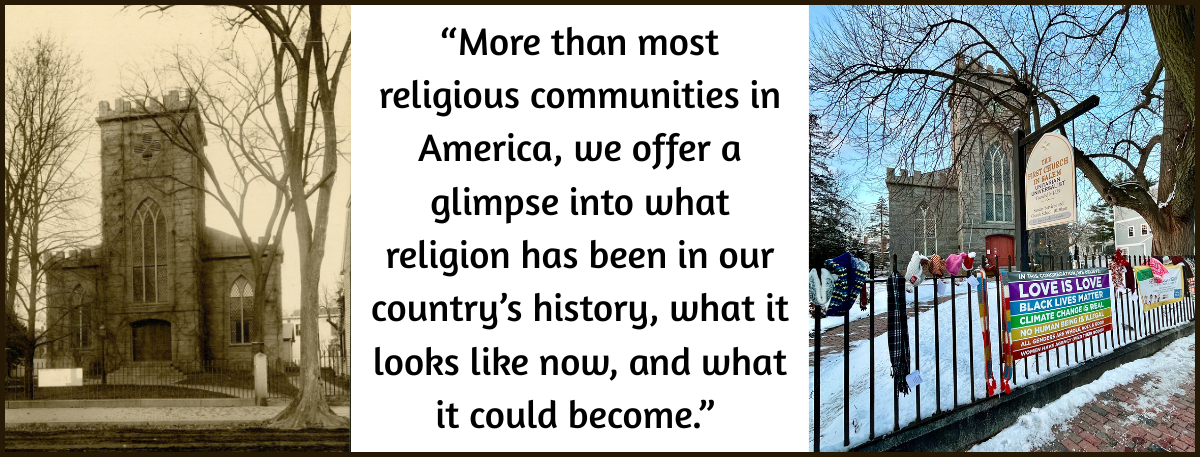
It’s not an accident that this church has become part of this larger conversation. We represent almost 400 years of changing religious life in America! The crew from CNN was particularly interested in how we’ve evolved from being one of the churches involved in the witch trials to a community that welcomes both Christians and Pagans (and lots of others!) and is led by a LGBTQ+ identified woman. More than most religious communities in America, we offer a glimpse into what religion has been in our country’s history, what it looks like now, and what it could become. 

Which is to say, it is an exciting and important time to be a part of this community! And you all get to decide what role this community will continue to play in the unfolding story of religion and spirituality in America. How will we use our gifts, learn from and honor our history, and harness the unique spirit of this place to carry us into the future? What is the role not just of churches, and not just of UU churches, but of this particular church in the times in which we live? When I think about what sets this church apart from others I’ve been in, my mind goes to your welcoming spirit and knack for hospitality, your love of history and keen interest in the lessons it holds for us today, and your deep wellspring of creativity and appreciation for the role art, theatre, architecture, music, and even humour play in human flourishing. I can imagine so many ways we can harness these unique gifts in service of creating a more just and loving world. I’m sure you all have your own answers.

These questions are what we will begin answering through our mission and vision development. Building off of the work done by the transition team, we will come together this church year to craft and vote on mission and vision statements that will help steer our course for the future. And we need everyone’s involvement. Your first opportunity will be after service on Dec. 14th when Jerrie H. will lead us in a mission and vision workshop. There will also be an opportunity on zoom on December 30th and another in-person session after service on January 11th. I hope to see you at one of these important, inspiring, and imaginative conversations!

In faith,
Rev. Danielle

© Rev. Danielle Garrett, 2025
Minister's Message: The Season of Magic and Miracles

Welcome to the Season of Magic and Miracles

Friends, we are now officially in the winter holiday season. Advent begins this Sunday, Hanukkah begins in two weeks, and we are entering the longest nights of the year as we approach yule and the winter solstice later this month. These are days of storytelling and star gazing—days for lighting candles and preparing our hearts to receive the sacred wisdom of this season. These are days for embracing mystery, but that’s sometimes easier said than done. 

Recently, I decided to get in the holiday spirit by watching “A Christmas Carol.” I’ve heard the story countless times, but somehow the particular economic circumstances of the Cratchit family had never occurred to me. Clearly the family struggled financially, but Bob Cratchit must have some education to be able to manage Scrooge’s correspondences. What exactly did it mean to be a “clerk” in Victorian London anyway? Was it more like a secretary or an accountant? Was it that Scrooge paid significantly less than other businessmen who hired clerks? Or was 15 shillings a decent salary but with 4 kids, one of whom had significant complex health challenges, it wasn’t enough for the Cratchit’s particular circumstances. 

So now rather than watching the movie, I was furiously googling articles about the economy of Victorian London. Ultimately, a Christmas Carol is an allegory and a morality tale. It’s a ghost story for goodness sakes, with spirits who facilitate time travel! As much as Dickens was concerned with the plight of London’s poor, the exact and accurate mechanics of the Victorian economy is not what makes the story so enduring. “I will honour Christmas in my heart, and try to keep it all the year,” reads the famous line from the original text. Although I got distracted during this watch, I’ve read the story enough times to know that the lessons it holds are not about the history of clerks in London. 

It’s hard to remember a time when I didn’t have access to all of human knowledge in my pocket. When I would have a fleeting question or wondering and would just…wonder about it, then let it go. I think our recent ability to know everything immediately has somehow rewired our brains. We don’t have to experience not knowing little things anymore, so it makes those times when we don’t know big things especially anxiety producing. Who will win the midterm elections? How will we preserve democracy? How will we manage the climate crisis? Why are we here and what does it all mean? We lost the equivalent of practice tests or training runs for the very human experience of not knowing something.

The era we live in is called the information age for a reason. We worship at the altar of information, provided at lightning speeds. We stream events as they’re happening. We ingest this information like a sacrament. In this era, not knowing is increasingly unfamiliar and thus, increasingly uncomfortable. So, we try to get as much information as possible, even if it isn’t always helpful or true. We rush to answers, to explanations and certainties. But in the process, we lose our capacity to wonder and imagine. We forget that revelation isn’t closed and that we haven’t found all of the answers we need. 

I’ve heard some people express dismay at the idea of celebrating the winter holidays too joyfully during a time of economic and political uncertainty. We face serious problems, they say, and now is not the time for flying reindeers, twinkling lights, and fantastical stories. But I think we need to lean into our holiday tradition now more than ever.  Not as a form of escapism but as a way of keeping our hearts open to new possibilities. 

So friends, this December, give yourself over to the mysteries and miracles of this season. Just live in them. Don’t try to explain them. Don’t spend too much time googling their historical origin. 

Tell ghost stories that encourage us to be more giving and more joyful. Do not worry too much about if this ghost story is compatible with your theological beliefs about the afterlife. Believe the oil burned for eight days and in doing so, remember there is always time enough to preserve what is sacred. Believe that God incarnate came into the world by way of a young, unwed Palestinian girl and for the purpose of toppling empires. 

When we let ourselves believe these stories, even if just for a season or a night, our hearts and minds are opened to the idea that another world is possible—to the idea that there are ways forward we don’t know about, that something new can be born at any moment, and that our capacity for love and hope and justice isn’t at its limit. And In that opening of our hearts and minds, we make space for something new to be born in us. 

So during this season of magic and miracles, long-nights and twinkling light, let’s just let the mystery be. 

Happy Holidays, 

Rev. Danielle 

© Rev. Danielle Garrett, 2025
Minister's Message: Caring for Our Community Amidst Cruelty and Crisis

“If a brother or sister is naked and lacks daily food and one of you says to them, “Go in peace; keep warm and eat your fill,” and yet you do not supply their bodily needs, what is the good of that?” - James 2: 15-16

Friends, a cornerstone of my own faith is that everyone—literally everyone—is deserving of food, shelter, healthcare and community. I do not believe there are any circumstances under which it is just or moral to deny these basic human needs. And I believe that when we are able, it is our calling, as people of faith and members of the interdependent web of life, to help provide these necessities. Sure, I love book clubs that help educate us about social issues and I think it’s important that we work towards broader changes to eradicate system injustice. But I think there is something deeply holy about providing for one another’s immediate, tangible, bodily needs. I believe Jesus meant for us to take his assertion in Matthew chapter 5,  “For I was hungry and you gave me something to eat” literally.

Starting on November 1, SNAP benefits will be abruptly cut off, leaving many in our community without access to affordable food to feed their families. Over 83,000 households in Essex County rely on SNAP. This is not an inevitably, but rather a policy choice and an exceptionally cruel one. As Unitarian Universalists, who believe in the inherent dignity of each person, we are called to respond in this moment. So many of you are already giving, organizing, and sharing resources with your friends and family. Many of you have also asked how our congregation can care for our community during this time of need. I have been in touch with area organizations, including staff at the Salem Pantry, to let them know our church stands at the ready to serve our community in the coming days and weeks. Here are some of the most immediate ways we can help:

  • Contribute money at church: Cash donations are the most effective ways to support food pantries. With cash donations, food pantries can save time and money by buying in bulk and focusing on the items people need the most. To support these efforts, over the next two months we will be sharing 50% of our Sunday morning plate collection with area organizations. For the month of November, we will give half of our plate collection to the Salem Pantry. In December, we will contribute to LifeBridge. 

  • Donate non-perishable food items: While money is most effective, food donations are always welcome. This is a great option for children and youth, as the exercise of shopping for, pricing, and donating physical items helps kids learn about food insecurity and feel more tangibly connected to their giving. Our Religious Education staff and volunteers are organizing a food drive for the month of November. You are invited to donate non-perishable food items at church on Sunday mornings or at our Nov. 16th Potluck. 

  • Volunteer: As food pantries anticipate an increase in donations to process and guests to serve, they also anticipate needing more volunteers. The Salem Pantry is eager to welcome volunteers from First Church and plans to open up new volunteer spots at their market and warehouse in the coming days. You can sign up to volunteer here. 

  • Education and Advocacy: The most immediate action from food security advocates is a call for the USDA to release contingency funds that could help keep SNAP benefits going as the government shutdown continues. The Massachusetts based Project Bread has a letter you can fill out here. And the national Food Research and Action Council (FRAC) has a social media kit on their homepage if you’d like to use your channels to share information with family, friends and followers. 

  • Spiritual Grounding: While the crisis is immediate, the work to build a more equitable economic system where no one goes hungry is long-term work. We are more likely to stay committed for the long-haul if we have practices that renew us and spiritual grounding that reminds us why we are working for a more just and loving world. Maybe you’d like to spend some quiet time each morning meditating on our Unitarian Universalist values and discerning how you are called to live into them. Maybe you make time to engage with sacred scripture through a justice lense. Or perhaps you join us in reading and discussing our UU Common Read, Social Change Now: A Guide for Reflection and Connection by Deepa Iyer (see Theo’s message for more details!). Whatever you choose, don’t neglect the spiritual and theological dimensions of this important work.

I welcome your additional ideas for how First Church can show up to meet this moment and care for our community. And if you find yourself struggling financially, emotionally, or spiritually during these difficult days, please do not hesitate to reach out and set up an appointment with me.

Thank you for your care and courage.

In faith,

Rev. Danielle

Source: caring2025-10-29

Minister's Message: Finding Nourishment in Community

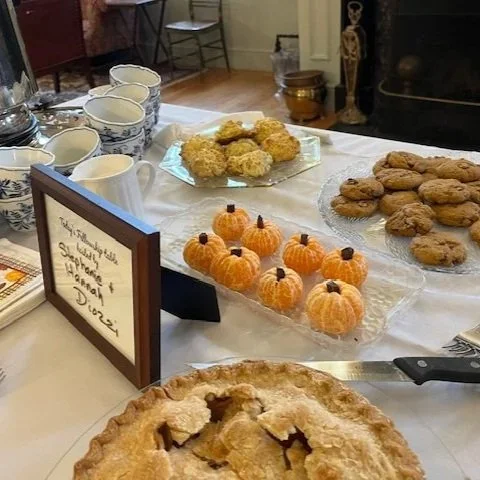
This week, I came across an article on social media from Duke Divinity’s Leadership Education publication. It’s titled “Coffee hour and the beauty of lingering with one another,” by Presbyterian minister Mihee Kim-Kort and it’s worth the read. It immediately made me think of you all, because fellowship hour here is indeed something special. When I first moved to town, before I even began my official first day of work, a neighbor (who is not a member here) remarked, “You’re at First Church?! You know they use REAL tea cups at coffee hour?” 

After reading the article, I realized this is the first congregation I’ve been in where the receiving line at the end of service happens not in the lobby by the exit, but by the doors that lead into the fellowship hall. Here we don’t “exit through the giftshop,” we “exit through the coffee hour.” 

While I recognize that can be an overwhelming prospect for introverts, there is something deeply poetic about it. At the close of the service, I speak a benediction—words to carry on your heart as I send you forth. But you do not hear them and then go your separate ways. You very deliberately add another step. You literally funnel and filter what we share together in worship through a space of community before taking it out into the world. Between time set aside for prayer, learning and contemplation and then the work of going about our lives, you make space for fellowship, nourishment, lingering, rest, and joy. 

The time spent together matters, even when no church business is happening (although I have been impressed at the impromptu uses of announcements and democratic process during fellowship to keep the work of the church churning along). It’s a reminder that between the work of grounding in our sacred values and the work of living those values out in the world, lies the work of community. We need people to help us discern what work is ours to do, support us, hold us accountable, and work alongside us, adding their gifts to our own. We need people to mourn and celebrate with. Even when it’s messy and even when it slows things down, in between the sanctuary and the streets, we need to spend time in community.

And those blue and white cups matter! I especially delight when I see our youth drinking from them. In a culture of disposability, waste, and hurrying, they offer an alternative set of values that counter the “on-the-go” ethic we’re so steeped in. They say, “stay a while.” They say “everyone deserves a bit of beauty and delight in their day.” They say, “this place is committed to something deeper, slower, more-lasting, and more sustainable than garishly colored trendy drinks in plastic to-go cups.” 

When we take time to slow down, to nourish and delight in one another’s company, we come into the presence of the holy. 

This Sunday is World Communion Sunday. We will bring this practice of breaking bread together into the sanctuary, so that we can see clearly the ways this work is always and inherently sacramental—a visible sign of the invisible presence of the divine. And this week in particular, I hunger and thirst for that truth. As news stories of violence, fear, division, and rising authoritarianism continue to flash across the screen, I need to be reminded that we can still meet one another at the table—that we can still honor one another’s humanity through small acts of care, beauty, and grace. I need to know that the presence of God is close at hand and we can still find them in the simple act of breaking bread.

If you need those same reminders, I hope you will join us for worship and communion this Sunday morning. All are welcome at this table.

And of course, there will still be fellowship hour.

In faith,

Rev. Danielle

© Rev. Danielle Garrett, 2025