Minister's Message: Moral Clarity and Courage

Finding Moral Clarity and Courage in the Face of State Sanctioned Violence

Dear ones, know that I am with you in your grief and your anger in these heavy days. The violent death of Renee Nicole Good at the hands of ICE officers in Minneapolis on Wednesday is a tragedy that leaves many of us at a loss for words. The administration’s false narrative painting Good as a “domestic terrorist” adds an additional Orwellian layer of fear. There is little I can say to assuage the pain so many of us are feeling as we process these events, but I can assure you that you are not alone as you rage and lament. Giving our feelings of grief and anger the time and space they deserve will help ensure our response to this injustice is borne out of a fierce and authentic love.

In my own rage and lament, I have found myself using the word “God” with a capital G more than anytime in recent memory. I have found myself uttering “My God,” praying simply, “God help us” and describing the events as “ungodly.” Most of you know that I ascribe to a theology that is expansive and playful, holding my understanding of God lightly. It is when I am most angry over injustice that I become reflexively theistic. The word is still imprecise, but in using it I see myself reaching for the power it carries in our society—the way it represents humans' feeble attempts to name that which is both utterly transcendent and palpably immanent. I use it when something feels so utterly misaligned with the goodness I believe rests at the heart of the universe, that it simply does not feel like enough to say, “this goes against my values.” 

I find myself reaching for the moral weight of the word to counter doubt, distraction, and gaslighting—to counter the administration’s attempts to convince me I don’t know the difference between good and evil when I see it. I want language that feels eternal, transcending shifting civic norms and reversible Supreme Court decisions. I want language with a moral weight that doesn’t require me to repeatedly watch and analyze a zoomed in, slow motion video of US agents shooting a human being at point blank range, before I decide whether or not that killing is immoral. 

So right now, I am reaching for “God” language. I might not forever. And I don’t expect you to. But I do want us to figure out how to sit with the full spiritual weight of what we’re witnessing. I want us to be able to find our way through the morass of pundits and commentators and facebook posts to reach the very ground of our being—the wellspring of our ethical commitments—and move forward from that place. 

Because this is a moment that demands moral clarity.

I say that in part, because I see the attempts to shift the moral goal posts and obscure the ethical issues at hand. I see the comments on the videos and news stories online saying, “This wouldn’t have happened if she complied with orders,” without any regard for the shock of fear and confusion when masked men are shouting conflicting orders with mere seconds to respond. These comments are also without any analysis of the virtues of those orders to begin with. They reject, on their face, any notion that we live in a society where non-compliance may be a moral imperative. To participate in this debate normalizes and condones ICE’s presence in the neighborhood to begin with. Rather than discussing the morality of ICE kidnapping our immigrant neighbors, we cede that ground to debate the morality of ICE killing those who are trying to prevent them from kidnapping our neighbors. When we start arguing about whether or not she “complied,” we have accepted the notion that the price for non-compliance with an unjust system is death. Legal or not, that’s simply not a moral system I can accept. 

In the days and weeks ahead, there will be opportunities for us to discuss as a community how our faith calls us to show up in this moment. I want to hear from you about how you want to get involved in the ongoing work to defend our immigrant neighbors, push back against fascist ideology, and fight for the values of love and justice we hold dear. But most of all, I want that work to come from a place of authentic spiritual grounding and deeply held ethical commitments. The stakes are too high for anything less.

So rage and lament. Feel your grief and acknowledge your fear. Mourn and honor the life of Renee Good. Do it all in the name of whatever it is you call sacred. And then offer gratitude for this community where, together, we can find the moral clarity and collective courage we need to ground us in this moment. 

I leave you with these words about order, disorder, and faithful noncompliance, written in 1968  by Daniel Berrigan on behalf of the nine people arrested for burning draft files in Catonsville, MD during the Vietnam War. They always bring me strength and courage in times such as these. You can read the full statement here.

“All of us who act against the law, turn to the poor of the world, to the Vietnamese, to the victims, to the soldiers who kill and die, for the wrong reasons, for no reason at all, because they were so ordered—by the authorities of that public order which is in effect a massive institutionalized disorder. We say: killing is disorder, life and gentleness and community and unselfishness is the only order we recognize. For the sake of that order, we risk our liberty, our good name.

In solidarity and love,
Rev. Danielle 

© Rev. Danielle Garrett, 2026

Sermon: "What Winter Reveals" (Rev. Danielle)

Pastoral Prayer:

Spirit of Life, God of peace and justice, hear our prayers this morning
It is a new year and even the most cynical among us harbor some glimmer of hope that it will be better than the last

and yet this turning of the calendar brings not of a dawn of peace, but news of war and we are reminded anew of the work we must do to enact the kingdom of heaven here on earth.

We know prayers for peace and justice are not enough on their own, but we hope they may serve as a beginning, a way to open our hearts and orient our spirits towards love

For the people of Venezuela we pray, we pray for safety, comfort, and justice, for self-determination and fair elections and the ability to flourish free from oppressive leaders at home and control and violence from abroad

For the members of our armed forces who are deployed and their loved ones we pray, we pray that they be held in love, kept safe from physical and spiritual harm and asked only to obey just and legal orders

For our leaders at home we pray, may they learn to lead with wisdom, love and compassion. May they be guided not by greed and lust for power but by the better angels of their nature. 

And for ourselves we pray, we pray for courage to speak out against violence and injustice, we pray for wisdom and patience as we discern our responses in a complex world, we pray that we may be guided by peace and love in this new year.

For this and for so much more left unspoken this morning, we pray.

Amen.


Sermon:

Friends, let me begin by saying I will, for the most part, be delivering the new years/winter themed sermon I planned today. I know yesterday’s United States military operation in Venezuela is on many of your minds, and this news brings many complex feelings and responses. I contemplated pivoting towards a sermon about peace, democracy, and unchecked power. And then I remembered German theologian Karl Barth’s declaration during the rise of the Nazi regime in Germany that the task was “to do theology and nothing but theology as though nothing had happened.” This was a strange statement coming from a Theologian who was instrumental in the formation of the confessing church that defied Hitler, was prohibited from writing and speaking in Germany, and eventually forced to flee the country. But Barth’s point was that in a world where an unjust regime was attempting to control so much of public life, we must resist their control over our spiritual life. This doesn’t mean we ignore what’s happening in the world and it doesn’t mean we don’t act on it. But it does mean that we do what we can to protect some sacred piece of autonomy. If the Trump administration controls what I preach every week, even if it’s preaching in defiance, that’s a lot of power we’re abdicating from this supposedly free pulpit. Theologian Hanna Reichel reminds us that they don’t need our love as long as they have our attention and our fear. So yes, let’s talk about if/how we as a community want to raise our voices for peace and justice. Let’s process how our faith calls us to respond in this moment. But let’s also tend to our souls for the long-term. Let’s find some spiritual fruits to nourish us for the new year and in doing so, remember that this administration and the news cycle don’t get to control what ideas we take the time to consider or how we grow spiritually. They don’t get to limit our imaginations and hijack our attention all the time. 

And before I was thinking about war, I was spending my New Years thinking about discernment. About how we find clarity and direction. And I was actually thinking about how I’ve managed to learn my way around the three new cities I’ve lived in in just  five years. In the age of GPS where we never have to navigate unassisted, this is no easy task. Portland in particular was hard for me. I think maybe it’s because the ocean was on the wrong side. I’m a child of the Atlantic. The water’s supposed to be to the east. And I never got used to the singular volcanic mountain peaks rising up seemingly out of nowhere. They were useless to me as navigational aids. Nashville didn’t offer quite the same level of geological confusion, but there was a park we walked in almost daily, with a massive tangle of side trails that left me regularly lost. 

In both places, things only begin to click into place with the coming of winter. As the leaves fall away, it becomes easier to see. On the side trails at that Nashville park, I suddenly had a sightline through the branches to the main walk and bike path. In Portland, the bare oak tree in front of my window allowed me to glimpse the intersections connecting my street to the rest of the neighborhood, letting me see the layout of the city more clearly. As much as I mourned the loss of the beautiful leafy views, the winter months helped me to, quite literally, find my bearings. And now I’m having that experience here in Salem. 

Almost every year in January, there are conversations about how it doesn’t feel right to start a new year in the winter. How we shouldn’t be making resolutions about fitness routines and bullet journals when most mammals are hibernating. Why don’t we start the new year in the fall we wonder, at harvest time, when school is back in session and summer vacations are winding down. This is when the Jewish New Year begins. Or in the spring, with new growth and new life blooming around us. This is when some Buddhist and Hindu traditions celebrate the new year. Often, I make peace with the Gregorian calendar’s winter new year by leaning into metaphors about how all life begins in the dark, whether in the womb or deep within the soil of the earth. I talk about the dormant period that is necessary before something new can grow.

But this year, it feels like we’ve been in the dark for more than just a season and it’s getting harder to make peace with it. This year, not even a week into 2026 and already on the brink of war, hibernating, while still necessary, feels impossible or irresponsible. So instead of reaching for the metaphors of winter’s long nights, I’m looking to the lessons of the short, but crystal clear days. Those unobstructed sightlines. The bare trees that provide us with an up close view of the earth’s scaffolding and allow us to see further into the distance than we could before. As I’ve learned in my attempts at navigating new cities, The leafless landscapes of these barren months provide us a chance to orient ourselves in an increasingly disorienting world. And that seems like a good way to start the new year. 

Writer Madeline L’Engle tells us that winter reveals the structure of things. Isn’t that such a great image? When the deciduous trees and plants are unadorned with leaves and blossoms, the trunk and branches are exposed. Although we might use words like empty, skeletal or bare to describe these trees, they are in reality quite magnificent. What we are glimpsing is the structure that carries, supports, and nourishes the colorful beauty through the rest of the seasons. This is the source from which so much bounty and joy blooms. In winter, things are laid bare and we can see how strong, how healthy the underlying structures really are. 

And so it is with our own lives as well. During times of loss or hardship, when we feel almost stripped bare, we are given a clearer view of the scaffolding that holds up our own lives. When fleeting things fall away, what remains at the center of your existence? Perhaps it’s your sense of self, your family and community, whether inherited or chosen, or maybe even your faith and spiritual life, your values system, your sense of belovedness as a child of God.

Winter can be a time to tend to these deep structures, to care for their health or to see them with new appreciative eyes. It can be a time of re-grounding in what is most important and ensuring that we are deeply rooted and able to support the weight of spring and summer’s fruits. I’ve often found winter a rich time to discover or deepen a spiritual practice, to spend time journaling, or in prayer or study. Perhaps, as we prepare to respond to the political realities in our country right now, winter is a good time to revisit the core values that drive our social activism. I’m contemplating launching an anti-fascist theology reading group this spring if there’s interest. Maybe you want to return to thinkers who write about non-violent resistance or radical hospitality. Maybe you want to go for long walks that help reconnect you with the earth, or volunteer at a direct service organization to reconnect you with your fellow humans. Do something to tend to the heartwood, the solid core of your soul that will hold you up and keep you in the work through failure, distraction, set-backs, and frustrations. 

We’re doing this as a church community too, as we hold conversations about our church’s mission and begin work on a right relations process, and bylaws revision. These are all part of asking who we are at our core? What is essential to the identity of this place. What are our roots, and trunk and branches? Perhaps some things we thought were branches are actually leaves, and they can fall away for a time without damaging the structure. Or maybe we’ll discover things we thought were merely decorative blooms actually help support the whole tree. I hope you’ll consider being part of some of these conversations. I know it’s not as fun as classes and protests and potlucks, but we need to tend to the structures for any of those other pieces to be successful. It’s the important winter work that keeps a church healthy. 

This kind of tending may seem really inward looking, but the thing about the winter landscape is at the same time it allows us to see more clearly the structure of things, it also allows us to see further. Winter is also a time for visioning. Without the leaves blocking our view, there is a spaciousness and clarity to the landscape that feels well suited to imaging new possibilities, for ourselves, our church, and our world. 

Maybe this winter is inviting you to ask what leaves in your life you need to let fall so you can see more clearly. It will look different for each of us, but I would guess we all have something in our life that is taking up too much space, obstructing our view, or preventing something new and beautiful from unfurling in its place. Can we let it go of whatever it is we’re so desperately clinging to? If we can, maybe in the clearing, we’ll be able see a new path for ourselves, like Annie Dillard’s assertion that in winter she could walk to the Gulf of Mexico in a straight line. Can you see a new vocation emerging, or maybe a way through a challenge that until now had seemed like an impasse. Can you see what our church might look like in five or ten years? How we could grow spiritually and the good work we could be doing in the world? Can you imagine what another world might look like if we stay committed to the work of love and justice? For in the winter, Dillard tells us, walls become windows and doors open. Paths unclog. All that summer conceals she said, winter reveals. I am reminded of Martha Postlethwaite’s poem “Clearing,” where she offers this invitation:

create
a clearing
in the dense forest
of your life
and wait there
patiently,
until the song
that is yours alone to sing
falls into your open cupped hands and you recognize and greet it. Only then will you know
how to give yourself
to the world
so worthy of rescue.

I love this concept of winter that Madeleine L’ENgle and Annie Dillard offer us. Winter as the time to tend to the structure of things, to make sure the bones are good while also looking towards distant horizons. Winter as a time to focus on both the bare essentials of the present and the wide open possibilities of the future. I love this because, for me, it hits a sweet spot between the winter urge to just hibernate and the social pressure to set really intense, productivity obsessed New Year's resolutions. It provides me with work to do in the New Year that is meaningful but gentle. Earnest but unrushed. I begin 2026 asking. How are the structures of my life holding up? What basics need tending?  And what kind of future can I see when I clear away the clutter? How am I making space for new possibilities to emerge?

And if I forget that those are my questions this season, if I get bogged down at work, distracted by the daily stressors of life, lost in the mess of 24 hours news networks and social media alerts, I can simply go outside for a winter walk on a clear day and find my bearings again.  

I hope 2026 brings us moments of joy, wonder, growth, and celebration. But I know it will likely also bring hard questions to answer, injustices to confront, and losses to grieve. All of those things will be easier if we do this winter work of assessing our structures and looking through the clearings towards new horizons. So this new year I invite you to embrace the spiritual gifts of this season. Let the winter landscape, in all it’s beautiful sparseness, guide you through this threshold.

May it be so. Happy New Year, dear ones. Amen. 


© Rev. Danielle Garrett, 2026

Minister's Message: The Year of Good Questions

Happy New Year, friends! I’m writing this on the morning of January 1st, having already broken my new year's resolution to reduce my screen time. I have a decidedly mixed track record when it comes to resolutions. Some years I resist the pressure to make them at all. Some years (like this one, apparently) I make one, but don’t even last a day. Other years, I have more success. The one’s I’ve managed to stick with often involve showing appreciation for others rather than attempting to better myself—resolutions like writing more thank you notes or paying for the content I consume by subscribing to favorite newsletters and podcasts.

Resolutions feel especially fraught this year. In the face of injustice, fearmongering, and rising fascist sentiment, it feels important to make firm commitments, take a stand, and live our values with unwavering courage even when it’s difficult. There is so much we need to be resolute about. And yet, certitude and rigidity have not served us well in recent memory. Each year seems more unpredictable, with new challenges that require imagination and flexibility to confront. In the face of increasing authoritarianism, I want to stay curious, soft-hearted, open-minded, resilient, and bendable enough to bounce back. A hard-and-fast commitment to any single behavior feels risky and even short-sighted.

So how then, do we approach the new year?

I am reminded of author and anthropologist Zora Neale Hurston’s famous assertion that “There are years that ask questions and years that answer.” If you, like me, are ambivalent towards resolutions right now, perhaps we embrace a “New Year’s Question(s)” instead. This year, let’s find a pointed, but loving question to carry us into 2026. Let’s choose a question we can ask ourselves when we’re feeling lost—not in hopes of finding a definitive answer but rather to gently guide our searching, wandering, and wondering. The question should be more compass than map.

Lutheran Minister and writer Nadia Bolz Weber offers one suggestion in her January 1 newsletter. Citing the mental health costs of spending so much time doom scrolling on social media and 24 hour news sites, she posits, “Perhaps this is the spiritual question for this new year: To what and to whom shall we give our attention?”

New York Times columnist Jancee Dunn talked to a number of psychologists and mental health experts to come up with seven questions to ask yourself as you reflect on the year past and prepare for the year ahead. They include:

  • When did you feel the most joyful and carefree?

  • What gave you energy — and what drained it?

  • What seemed impossible — but you did it anyway?

  • What habit, if you did it more consistently, would have a positive effect on your life?

  • What did you try to control that was actually outside your control?

  • Is there anyone you need to forgive in 2026?

As we continue our conversations around mission and vision as a church, it occurs to me that we could ask these questions in the context of our life together as a congregation. I imagine any of them would generate a fruitful and informative conversation!

But there are so many possibilities. Our UU values might prompt us to ask, “How am I keeping love at the center?” Howard Thurman wrote, "Don't ask what the world needs. Ask what makes you come alive, and go do it. Because what the world needs is people who have come alive." In Wendell Berry's poem “Manifesto: The Mad Farmer’s Liberation Front,” he advises, “Ask yourself: Will this satisfy a woman satisfied to bear a child? Will this disturb the sleep of a woman near to giving birth?”

I do not know what 2026 will bring for our community and the world, so I can’t promise you I will have all the answers we’ll need. In fact, I can almost guarantee I won’t! But I can promise you that we can learn to ask good questions, and live into those questions together. Whole worlds have been created, revolutions sparked, and loves ignited with a good question. So, we could do worse.

Blessings for 2026. I hope it has moments of joy, growth, ease, and wonder, whatever else it holds. I look forward to spending it with all of you.

In faith and love,
Rev. Danielle

© Rev. Danielle Garrett, 2026

Christmas Eve Homily: Uninvited Love (Rev. Danielle)

Each Christmas as I read this famous story, I find myself focusing on a different character, identifying with a different part of the story. Some years we’re like Mary, both tenderly and fiercely protecting the sacred within us. Some years, maybe we feel like Joseph, neglected, underappreciated but still quietly doing the right thing. Maybe we’re the magi, trying to find a new way home for ourselves after a life changing revelation. 

But this year, I’ve been thinking about the inn keeper—often portrayed as something of a minor villain, but I think, painfully relatable. Maybe some of you have hosted or are preparing to host guests during this holiday season and feel exhausted, like you want to post a “no room at the inn” sign on the door (If you are an out of town visitor here with someone tonight, I am sure you are an exemplary guest and that is not the case for your host). 

But seriously, I think the inn keeper gets a bad rap. We don’t have all the backstory. We don’t know what was going on in their life before Mary and Joseph showed up at their door. There must have been a lot of travellers, for Luke tells us a decree went out to all the land and all had to return to their towns to be registered. We don’t know how many other weary travelers had already come looking for shelter that night. Or how many of the inn’s employees were themselves travelling for the census, leaving our harried inn keeper short staffed. Maybe he believed stories he’d heard that some of these travellers were criminals, very dangerous people, using the census as an opportunity to scam small business owners. For all we know, the inn keeper had spent the day organizing a No King Herod protest and Mary and Joseph found him when his empathy had worn thin. He was burnt out. He was listening to his therapist and setting boundaries. 

I can easily come up with a hundred plausible reasons why the inn keeper turned away Mary and Joseph, probably because I can easily come up with a hundred plausible reasons why I might have done the same. And why I do, why we all do, every day. At the end of the day aren’t we most often like the inn keeper? Trying to do our jobs and care for our families, trying to decide which battles are worth fighting, and trying to get through another day living in the shadow of empire, with an insecure and greedy king breathing down our necks. 

We may aspire to live lives where we see Christ in every person we meet, where we treat every unhoused neighbor, every hungry child, every immigrant family as holy, but we don’t. We pretend to be on the phone when a canvasser asks us to donate to charity, we avoid eye contact with the person asking for change on the street corner, we ignore the alerts that ICE is in the neighborhood because we’re busy with work or kids. We aspire to live out the lessons of the Christ child story, but nearly every day we fall short. It’s almost impossible not to. There is so much suffering and need all around us.

And that’s, in part, by design. Those in power, both then and now, need us operating with a mindset of fear and scarcity. They need us to make decisions out of resignation, overwhelm, and exhaustion. They need us unsure of if and how we should care for our neighbor. Because that’s how they uphold their power. 

The Roman empire didn’t want a new king to be born— one who casts down the mighty and brings a reign of justice and peace. They had a vested interest in making sure there was no room at the inn. 

The census described in Luke was no simple head count. Theologian Kat Armas writes, “A census in the Roman world was a tool of the empire. Censuses existed to assess taxes, conscript labor and make land and people legible to empire’s control. To be counted was to be claimed- your body and your labor. The holy family does not travel because of prophecy or devotion but because of bureaucratic coercion.” There was no room in the inn not just because the innkeeper was unsympathetic, but because the Roman empire’s actions ensured there was no room in the inn.

Through tactics of coercion and control they ensured there was no convenient place for hope, peace, joy and love to be born.

So then how do we respond in our own time, as weary innkeepers who want to do the right thing, living in a world that makes it increasingly difficult? 

We ready the inconvenient places.

We get creative. We prepare the mangers and the stables. We go to the places on the margins that the forces of hatred and greed dismiss and overlook and we make them into maternity wards for sacred, revolutionary love. 

And there we write a new story, a more liberating story, a story of hope that can only be written from locations that lie outside of the empire’s limited imagination.


In this story, Hope is not born at some elite address in a gated community, but outside under the stars, with a navigation system accessible to all.

In this story, peace is born amongst the animals, helping us understand that there is no true peace without an acknowledgment of our interdependence with all of creation, without an understanding of our place in the interconnected web of life.  

In this story, joy is born in a stable, a humble place where no one feels excluded from entering and where there is room to welcome and share good news with all people, even lowly shepherds.

And in this story, love is born in a manger, a feeding trough for animals, reminding us that love is not merely a decoration to be gazed at but a powerful and active force, meant to be put to use. This love is food for the hungry and nourishment for the soul.

Whatever the inn keepers' faults, what he is able to offer, this imperfect solution that circumvents an unjust government’s best laid plans, is more than enough to allow this new story to take hold. 

Thomas Merton wrote,“Into this world, this demented inn, in which there is absolutely no room for him at all, Christ comes uninvited.” Thankfully for us, the Christmas story is one of humility and grace and a power greater than any one of us. Christ comes. Even though there is no room, even though the conditions aren’t perfect, even though the empire is mighty, even though we fail to live up to our professed ideals, Christ comes. Still. God conspires with the marginalized and powerless to birth love into an unwelcoming world again and again. 

So on the days when we don’t feel like Mary or Joseph or even the shepherds, brave enough to follow the words of an angel and the direction of a star—on the days where we feel most like the innkeeper, simply struggling to do the best we can in a broken world, may we remember the power of this story. We don’t have to be perfect, we don’t have to fix everything, we don’t have to topple empires by ourselves. We just have to be creative and courageous enough to carve out a little extra space, however unconventional, where love can be born.

May it be so. Merry Christmas, dear ones. Amen.

© Rev. Danielle Garrett, 2025

Minister's Message: RItuals, Rites of Passage, and Sacred Promises

This Sunday during service, before the eagerly anticipated annual Christmas pageant, Theo and I will have the great joy of leading a child dedication ceremony for two of the youngest members of our community. At Christmas time! In front of the manger set! 

This will be my first child dedication as an ordained minister and it’s a rite of passage I have been looking forward to. I first felt a call to ministry on August 27, 2017. The call was sudden and clear, seeming to come from somewhere deep inside and far beyond at the same time. It was during a Sunday service at All Souls in Washington DC, but it did not happen during a rousing sermon, a moving piece of choral music, or a moment of prayer. It came during a child dedication. It came to me in the midst of a ritual rooted in community, where we recognize our interdependence and promise to help care for one another. It came in the moments the congregation read these words of promise from our hymnal, written by Rev. Rob Eller-Isaacs: “May we be worthy guardians of this young life. May we build a community in which they will grow old surrounded by beauty, embraced by love, and cradled in the arms of peace.”

I get choked up every time I read those words. What a sacred responsibility! What a precious gift! I can not imagine more meaningful work than that. It’s a lifetime’s work. It’s life-giving, life-saving, life-sustaining work. If it’s the only work we commit ourselves to during our time on this earth, it is enough. It’s work I have witnessed you all doing with an uncommon kind of commitment and joy. Truly, I have not been in another church community where the young people were so welcome, respected, cherished, engaged, and loved. It is a beautiful thing to behold.

It feels especially urgent and hopeful to make these promises to our youngest members, but really, as a faith community, this is what we strive to do for one another every day, and for each and every person who walks through our doors, regardless of age. Because, in the words of Ram Dass, “We are all just walking each other home.” I could imagine it as a kind of quiet prayer we whisper each time we step through the threshold into our church building: “May we be worthy guardians of one another.”

For me, this is the power of rituals and rites-of-passage ceremonies in church. They call us back to our deepest values and to our sacred center in a way that a sermon or intellectual discussion usually can’t. Native American botanist, author, and educator Robin Wall Kimmerer writes, “Ceremony can bring the quiescent back to life; it can open your mind and heart to what you once knew but have forgotten.” When we make promises to our children, to our beloved, to our ancestors, to our new church members, or when we witness others make those promises, we are both recommitting ourselves to our life’s sacred purpose and reawakening our souls to an awareness of that purpose. There is a reason many of us cry at weddings and funerals, even of those we don’t know well. 

If there is a moment of transition, commitment, or dedication you would like to mark in your own life, know that this is a community that makes space for that. I hope you’ll reach out if you’re considering a child dedication, wedding, vow renewal, name change ceremony, etc. I hope you will all join us in the meeting house or on zoom Sunday to witness and participate in our child dedication ceremony. And I hope in making these promises to our young people, it will give you a chance to reflect on the promises we make to one another. May we be worthy guardians indeed.

In faith,
Rev. Danielle 

© Rev. Danielle Garrett, 2025

Minister's Message: Celebrating Hanukkah...

Celebrating Hanukkah and Honoring our Religious Diversity

This Sunday night is the first night of Hanukkah. Last year, the first night of Hanukkah fell on Christmas Eve and I celebrated with our interfaith extended family. We fried latkes and lit the Menorah and I practiced my Hebrew pronunciation with my 4 year old niece. Then we opened presents and checked the NORAD Santa tracker and I marveled at the joy and ease with which these children embraced both of their religious traditions. I wondered how they will make them their own as they grow and their own faith and spirituality changes and evolves. I was also serving in a congregation with Jewish UU minister, and through participating in Jewish rituals with her, I learned more about the ways our Unitarian Universalist faith is enhanced when we engage with the other identities and religious traditions we bring into the space.

This year I won’t be with my Jewish family members, teachers and friends on Hanukkah. And I confess to a certain amount of discomfort lighting a Menorah, which is meant to be lit after dark, on a sunny Sunday morning in church. Afterall, the contrast between the light and the darkness is the whole point of the tradition. Embracing the religious pluralism of Unitarian Universalism isn’t just about checking a certain number of boxes. It’s about honoring that there are many paths to the sacred, learning from them, and engaging with them honestly, respectfully and deeply—not just on a surface level. It’s also about realizing we can find meaning in a spiritual path and also recognize it isn’t ours to follow. So as a non-Jewish UU, I’ve been thinking about how I will mark the holiday this year.

I’ll take some time to reflect on the miracles I’ve experienced in my own life, to honor acts of resistance by those living under oppression, and to remember our shared calling to keep the flames of hope, love, and justice burning. I’ll send Hanukkah wishes to those I love. I’ll tell my nieces how much it meant to me to celebrate with them last year and check in on how our Hebrew pronunciation is progressing.

And I’ll continue to celebrate the blessings of our religiously plural tradition—the ways my own faith and spirituality are enhanced when I’m in community and conversation with beloveds from other traditions, including Judaism. I’m currently reading A Child is Born, a new advent study from Dr. Amy Jill Levine, my professor in Divinity School. Levine is a Jewish woman whose work places the New Testament stories, including the nativity story, in their Jewish context. The stories are made even richer, more meaningful, and more fun and interesting to study as a result. Her work is another example of how interfaith engagement continues to deepen my own religious life.

If you celebrate Hanukkah or will be spending time with family and friends who celebrate this December, I hope the festival of lights holds joys, blessings, and lessons for you this year. I leave you with this Hanukkah Prayer by Marla Baker.

In faith
Rev. Danielle

© Rev. Danielle Garrett, 2025

Minister's Message: 400 Years of History, 15 Minutes of Fame...

400 Years of History, 15 Minutes of Fame, and a Vision to Carry Us Into the Future

In case you missed it, CNN reporter Donie O’Sullivan visited Salem back in September. I spoke with him for his new CNN series “Devoted,” which explores how people are searching for meaning, ritual, and belonging, amidst America’s changing religious landscape. You can watch the episode here, but you’ll either need to subscribe or log-in with your cable provider. He was also recently on reporter Audie Cornish’s podcast to discuss religion in America today and briefly mentioned First Church. 

There is growing media interest in the role religion plays in our modern social and political life. While the number of those who identify as traditionally “religious” has decreased consistently in recent decades, it seems to have plateaued recently. And those declining numbers never told the full story of what was happening to begin with. Young men are flocking to orthodox and conservative religious communities in increasing numbers. Women and LGBTQ+ folks are seeking out more affirming spaces, including pagan traditions that honor our connection with the earth and the power within each of us. People are finding ritual and spiritual practice through yoga, mindfulness, and wellness culture. And there is increasing interest and concern over the role AI and technology will play in our spiritual life. Podcaster Jo Rogan even wondered if the second coming of Christ might be through Artificial Intelligence, another form of immaculate conception (an idea, it should go without saying, that I do not endorse). The point is, there is a major shift happening in our country’s religious life and people are starting to notice. 

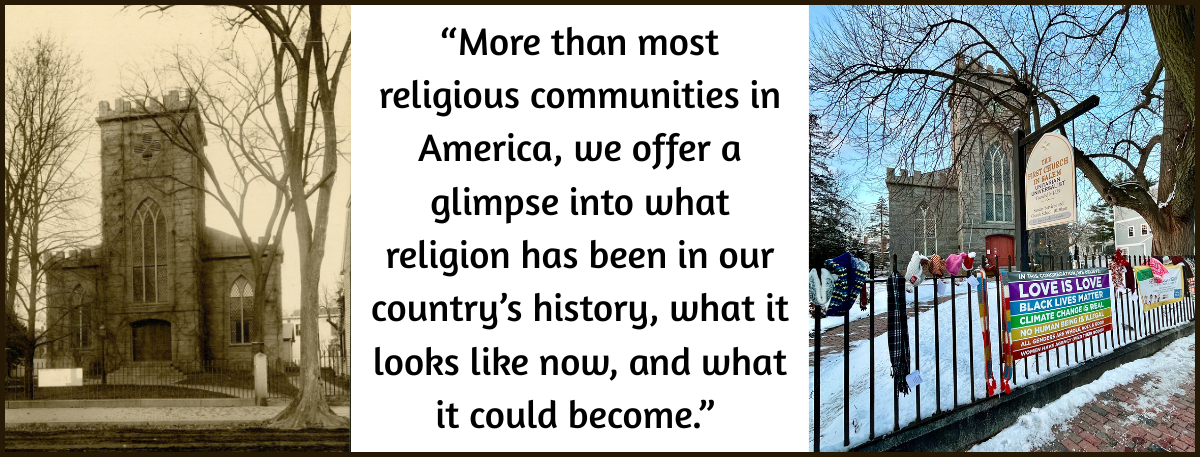
It’s not an accident that this church has become part of this larger conversation. We represent almost 400 years of changing religious life in America! The crew from CNN was particularly interested in how we’ve evolved from being one of the churches involved in the witch trials to a community that welcomes both Christians and Pagans (and lots of others!) and is led by a LGBTQ+ identified woman. More than most religious communities in America, we offer a glimpse into what religion has been in our country’s history, what it looks like now, and what it could become. 

Which is to say, it is an exciting and important time to be a part of this community! And you all get to decide what role this community will continue to play in the unfolding story of religion and spirituality in America. How will we use our gifts, learn from and honor our history, and harness the unique spirit of this place to carry us into the future? What is the role not just of churches, and not just of UU churches, but of this particular church in the times in which we live? When I think about what sets this church apart from others I’ve been in, my mind goes to your welcoming spirit and knack for hospitality, your love of history and keen interest in the lessons it holds for us today, and your deep wellspring of creativity and appreciation for the role art, theatre, architecture, music, and even humour play in human flourishing. I can imagine so many ways we can harness these unique gifts in service of creating a more just and loving world. I’m sure you all have your own answers.

These questions are what we will begin answering through our mission and vision development. Building off of the work done by the transition team, we will come together this church year to craft and vote on mission and vision statements that will help steer our course for the future. And we need everyone’s involvement. Your first opportunity will be after service on Dec. 14th when Jerrie H. will lead us in a mission and vision workshop. There will also be an opportunity on zoom on December 30th and another in-person session after service on January 11th. I hope to see you at one of these important, inspiring, and imaginative conversations!

In faith,
Rev. Danielle

© Rev. Danielle Garrett, 2025