Christmas Eve Homily: Uninvited Love (Rev. Danielle)

Each Christmas as I read this famous story, I find myself focusing on a different character, identifying with a different part of the story. Some years we’re like Mary, both tenderly and fiercely protecting the sacred within us. Some years, maybe we feel like Joseph, neglected, underappreciated but still quietly doing the right thing. Maybe we’re the magi, trying to find a new way home for ourselves after a life changing revelation. 

But this year, I’ve been thinking about the inn keeper—often portrayed as something of a minor villain, but I think, painfully relatable. Maybe some of you have hosted or are preparing to host guests during this holiday season and feel exhausted, like you want to post a “no room at the inn” sign on the door (If you are an out of town visitor here with someone tonight, I am sure you are an exemplary guest and that is not the case for your host). 

But seriously, I think the inn keeper gets a bad rap. We don’t have all the backstory. We don’t know what was going on in their life before Mary and Joseph showed up at their door. There must have been a lot of travellers, for Luke tells us a decree went out to all the land and all had to return to their towns to be registered. We don’t know how many other weary travelers had already come looking for shelter that night. Or how many of the inn’s employees were themselves travelling for the census, leaving our harried inn keeper short staffed. Maybe he believed stories he’d heard that some of these travellers were criminals, very dangerous people, using the census as an opportunity to scam small business owners. For all we know, the inn keeper had spent the day organizing a No King Herod protest and Mary and Joseph found him when his empathy had worn thin. He was burnt out. He was listening to his therapist and setting boundaries. 

I can easily come up with a hundred plausible reasons why the inn keeper turned away Mary and Joseph, probably because I can easily come up with a hundred plausible reasons why I might have done the same. And why I do, why we all do, every day. At the end of the day aren’t we most often like the inn keeper? Trying to do our jobs and care for our families, trying to decide which battles are worth fighting, and trying to get through another day living in the shadow of empire, with an insecure and greedy king breathing down our necks. 

We may aspire to live lives where we see Christ in every person we meet, where we treat every unhoused neighbor, every hungry child, every immigrant family as holy, but we don’t. We pretend to be on the phone when a canvasser asks us to donate to charity, we avoid eye contact with the person asking for change on the street corner, we ignore the alerts that ICE is in the neighborhood because we’re busy with work or kids. We aspire to live out the lessons of the Christ child story, but nearly every day we fall short. It’s almost impossible not to. There is so much suffering and need all around us.

And that’s, in part, by design. Those in power, both then and now, need us operating with a mindset of fear and scarcity. They need us to make decisions out of resignation, overwhelm, and exhaustion. They need us unsure of if and how we should care for our neighbor. Because that’s how they uphold their power. 

The Roman empire didn’t want a new king to be born— one who casts down the mighty and brings a reign of justice and peace. They had a vested interest in making sure there was no room at the inn. 

The census described in Luke was no simple head count. Theologian Kat Armas writes, “A census in the Roman world was a tool of the empire. Censuses existed to assess taxes, conscript labor and make land and people legible to empire’s control. To be counted was to be claimed- your body and your labor. The holy family does not travel because of prophecy or devotion but because of bureaucratic coercion.” There was no room in the inn not just because the innkeeper was unsympathetic, but because the Roman empire’s actions ensured there was no room in the inn.

Through tactics of coercion and control they ensured there was no convenient place for hope, peace, joy and love to be born.

So then how do we respond in our own time, as weary innkeepers who want to do the right thing, living in a world that makes it increasingly difficult? 

We ready the inconvenient places.

We get creative. We prepare the mangers and the stables. We go to the places on the margins that the forces of hatred and greed dismiss and overlook and we make them into maternity wards for sacred, revolutionary love. 

And there we write a new story, a more liberating story, a story of hope that can only be written from locations that lie outside of the empire’s limited imagination.


In this story, Hope is not born at some elite address in a gated community, but outside under the stars, with a navigation system accessible to all.

In this story, peace is born amongst the animals, helping us understand that there is no true peace without an acknowledgment of our interdependence with all of creation, without an understanding of our place in the interconnected web of life.  

In this story, joy is born in a stable, a humble place where no one feels excluded from entering and where there is room to welcome and share good news with all people, even lowly shepherds.

And in this story, love is born in a manger, a feeding trough for animals, reminding us that love is not merely a decoration to be gazed at but a powerful and active force, meant to be put to use. This love is food for the hungry and nourishment for the soul.

Whatever the inn keepers' faults, what he is able to offer, this imperfect solution that circumvents an unjust government’s best laid plans, is more than enough to allow this new story to take hold. 

Thomas Merton wrote,“Into this world, this demented inn, in which there is absolutely no room for him at all, Christ comes uninvited.” Thankfully for us, the Christmas story is one of humility and grace and a power greater than any one of us. Christ comes. Even though there is no room, even though the conditions aren’t perfect, even though the empire is mighty, even though we fail to live up to our professed ideals, Christ comes. Still. God conspires with the marginalized and powerless to birth love into an unwelcoming world again and again. 

So on the days when we don’t feel like Mary or Joseph or even the shepherds, brave enough to follow the words of an angel and the direction of a star—on the days where we feel most like the innkeeper, simply struggling to do the best we can in a broken world, may we remember the power of this story. We don’t have to be perfect, we don’t have to fix everything, we don’t have to topple empires by ourselves. We just have to be creative and courageous enough to carve out a little extra space, however unconventional, where love can be born.

May it be so. Merry Christmas, dear ones. Amen.

© Rev. Danielle Garrett, 2025
Minister's Message: RItuals, Rites of Passage, and Sacred Promises

This Sunday during service, before the eagerly anticipated annual Christmas pageant, Theo and I will have the great joy of leading a child dedication ceremony for two of the youngest members of our community. At Christmas time! In front of the manger set! 

This will be my first child dedication as an ordained minister and it’s a rite of passage I have been looking forward to. I first felt a call to ministry on August 27, 2017. The call was sudden and clear, seeming to come from somewhere deep inside and far beyond at the same time. It was during a Sunday service at All Souls in Washington DC, but it did not happen during a rousing sermon, a moving piece of choral music, or a moment of prayer. It came during a child dedication. It came to me in the midst of a ritual rooted in community, where we recognize our interdependence and promise to help care for one another. It came in the moments the congregation read these words of promise from our hymnal, written by Rev. Rob Eller-Isaacs: “May we be worthy guardians of this young life. May we build a community in which they will grow old surrounded by beauty, embraced by love, and cradled in the arms of peace.”

I get choked up every time I read those words. What a sacred responsibility! What a precious gift! I can not imagine more meaningful work than that. It’s a lifetime’s work. It’s life-giving, life-saving, life-sustaining work. If it’s the only work we commit ourselves to during our time on this earth, it is enough. It’s work I have witnessed you all doing with an uncommon kind of commitment and joy. Truly, I have not been in another church community where the young people were so welcome, respected, cherished, engaged, and loved. It is a beautiful thing to behold.

It feels especially urgent and hopeful to make these promises to our youngest members, but really, as a faith community, this is what we strive to do for one another every day, and for each and every person who walks through our doors, regardless of age. Because, in the words of Ram Dass, “We are all just walking each other home.” I could imagine it as a kind of quiet prayer we whisper each time we step through the threshold into our church building: “May we be worthy guardians of one another.”

For me, this is the power of rituals and rites-of-passage ceremonies in church. They call us back to our deepest values and to our sacred center in a way that a sermon or intellectual discussion usually can’t. Native American botanist, author, and educator Robin Wall Kimmerer writes, “Ceremony can bring the quiescent back to life; it can open your mind and heart to what you once knew but have forgotten.” When we make promises to our children, to our beloved, to our ancestors, to our new church members, or when we witness others make those promises, we are both recommitting ourselves to our life’s sacred purpose and reawakening our souls to an awareness of that purpose. There is a reason many of us cry at weddings and funerals, even of those we don’t know well. 

If there is a moment of transition, commitment, or dedication you would like to mark in your own life, know that this is a community that makes space for that. I hope you’ll reach out if you’re considering a child dedication, wedding, vow renewal, name change ceremony, etc. I hope you will all join us in the meeting house or on zoom Sunday to witness and participate in our child dedication ceremony. And I hope in making these promises to our young people, it will give you a chance to reflect on the promises we make to one another. May we be worthy guardians indeed.

In faith,
Rev. Danielle 

© Rev. Danielle Garrett, 2025

Minister's Message: Celebrating Hanukkah...

Celebrating Hanukkah and Honoring our Religious Diversity

This Sunday night is the first night of Hanukkah. Last year, the first night of Hanukkah fell on Christmas Eve and I celebrated with our interfaith extended family. We fried latkes and lit the Menorah and I practiced my Hebrew pronunciation with my 4 year old niece. Then we opened presents and checked the NORAD Santa tracker and I marveled at the joy and ease with which these children embraced both of their religious traditions. I wondered how they will make them their own as they grow and their own faith and spirituality changes and evolves. I was also serving in a congregation with Jewish UU minister, and through participating in Jewish rituals with her, I learned more about the ways our Unitarian Universalist faith is enhanced when we engage with the other identities and religious traditions we bring into the space.

This year I won’t be with my Jewish family members, teachers and friends on Hanukkah. And I confess to a certain amount of discomfort lighting a Menorah, which is meant to be lit after dark, on a sunny Sunday morning in church. Afterall, the contrast between the light and the darkness is the whole point of the tradition. Embracing the religious pluralism of Unitarian Universalism isn’t just about checking a certain number of boxes. It’s about honoring that there are many paths to the sacred, learning from them, and engaging with them honestly, respectfully and deeply—not just on a surface level. It’s also about realizing we can find meaning in a spiritual path and also recognize it isn’t ours to follow. So as a non-Jewish UU, I’ve been thinking about how I will mark the holiday this year.

I’ll take some time to reflect on the miracles I’ve experienced in my own life, to honor acts of resistance by those living under oppression, and to remember our shared calling to keep the flames of hope, love, and justice burning. I’ll send Hanukkah wishes to those I love. I’ll tell my nieces how much it meant to me to celebrate with them last year and check in on how our Hebrew pronunciation is progressing.

And I’ll continue to celebrate the blessings of our religiously plural tradition—the ways my own faith and spirituality are enhanced when I’m in community and conversation with beloveds from other traditions, including Judaism. I’m currently reading A Child is Born, a new advent study from Dr. Amy Jill Levine, my professor in Divinity School. Levine is a Jewish woman whose work places the New Testament stories, including the nativity story, in their Jewish context. The stories are made even richer, more meaningful, and more fun and interesting to study as a result. Her work is another example of how interfaith engagement continues to deepen my own religious life.

If you celebrate Hanukkah or will be spending time with family and friends who celebrate this December, I hope the festival of lights holds joys, blessings, and lessons for you this year. I leave you with this Hanukkah Prayer by Marla Baker.

In faith
Rev. Danielle

© Rev. Danielle Garrett, 2025

Minister's Message: 400 Years of History, 15 Minutes of Fame...

400 Years of History, 15 Minutes of Fame, and a Vision to Carry Us Into the Future

In case you missed it, CNN reporter Donie O’Sullivan visited Salem back in September. I spoke with him for his new CNN series “Devoted,” which explores how people are searching for meaning, ritual, and belonging, amidst America’s changing religious landscape. You can watch the episode here, but you’ll either need to subscribe or log-in with your cable provider. He was also recently on reporter Audie Cornish’s podcast to discuss religion in America today and briefly mentioned First Church. 

There is growing media interest in the role religion plays in our modern social and political life. While the number of those who identify as traditionally “religious” has decreased consistently in recent decades, it seems to have plateaued recently. And those declining numbers never told the full story of what was happening to begin with. Young men are flocking to orthodox and conservative religious communities in increasing numbers. Women and LGBTQ+ folks are seeking out more affirming spaces, including pagan traditions that honor our connection with the earth and the power within each of us. People are finding ritual and spiritual practice through yoga, mindfulness, and wellness culture. And there is increasing interest and concern over the role AI and technology will play in our spiritual life. Podcaster Jo Rogan even wondered if the second coming of Christ might be through Artificial Intelligence, another form of immaculate conception (an idea, it should go without saying, that I do not endorse). The point is, there is a major shift happening in our country’s religious life and people are starting to notice. 

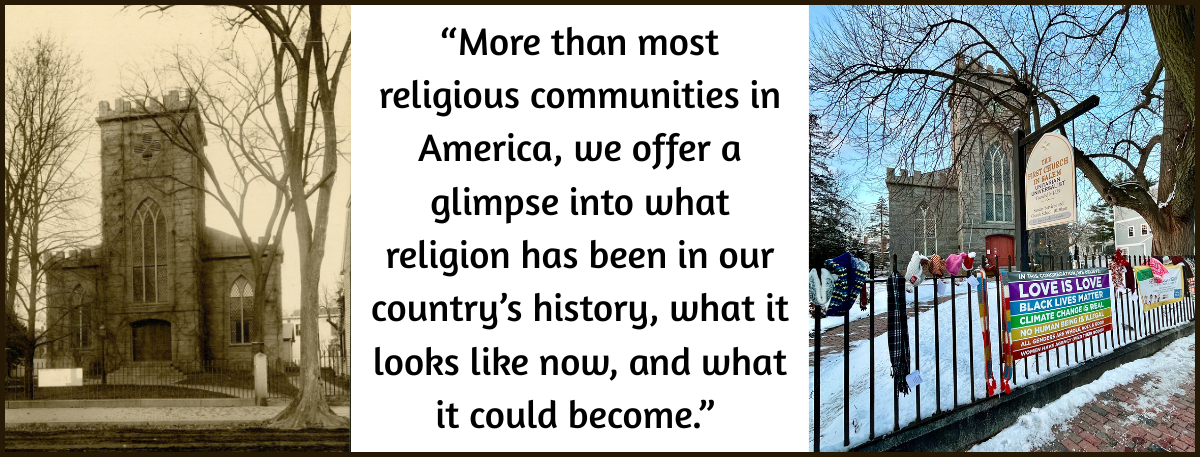
It’s not an accident that this church has become part of this larger conversation. We represent almost 400 years of changing religious life in America! The crew from CNN was particularly interested in how we’ve evolved from being one of the churches involved in the witch trials to a community that welcomes both Christians and Pagans (and lots of others!) and is led by a LGBTQ+ identified woman. More than most religious communities in America, we offer a glimpse into what religion has been in our country’s history, what it looks like now, and what it could become. 

Which is to say, it is an exciting and important time to be a part of this community! And you all get to decide what role this community will continue to play in the unfolding story of religion and spirituality in America. How will we use our gifts, learn from and honor our history, and harness the unique spirit of this place to carry us into the future? What is the role not just of churches, and not just of UU churches, but of this particular church in the times in which we live? When I think about what sets this church apart from others I’ve been in, my mind goes to your welcoming spirit and knack for hospitality, your love of history and keen interest in the lessons it holds for us today, and your deep wellspring of creativity and appreciation for the role art, theatre, architecture, music, and even humour play in human flourishing. I can imagine so many ways we can harness these unique gifts in service of creating a more just and loving world. I’m sure you all have your own answers.

These questions are what we will begin answering through our mission and vision development. Building off of the work done by the transition team, we will come together this church year to craft and vote on mission and vision statements that will help steer our course for the future. And we need everyone’s involvement. Your first opportunity will be after service on Dec. 14th when Jerrie H. will lead us in a mission and vision workshop. There will also be an opportunity on zoom on December 30th and another in-person session after service on January 11th. I hope to see you at one of these important, inspiring, and imaginative conversations!

In faith,
Rev. Danielle

© Rev. Danielle Garrett, 2025

Minister's Message: The Season of Magic and Miracles

Welcome to the Season of Magic and Miracles

Friends, we are now officially in the winter holiday season. Advent begins this Sunday, Hanukkah begins in two weeks, and we are entering the longest nights of the year as we approach yule and the winter solstice later this month. These are days of storytelling and star gazing—days for lighting candles and preparing our hearts to receive the sacred wisdom of this season. These are days for embracing mystery, but that’s sometimes easier said than done. 

Recently, I decided to get in the holiday spirit by watching “A Christmas Carol.” I’ve heard the story countless times, but somehow the particular economic circumstances of the Cratchit family had never occurred to me. Clearly the family struggled financially, but Bob Cratchit must have some education to be able to manage Scrooge’s correspondences. What exactly did it mean to be a “clerk” in Victorian London anyway? Was it more like a secretary or an accountant? Was it that Scrooge paid significantly less than other businessmen who hired clerks? Or was 15 shillings a decent salary but with 4 kids, one of whom had significant complex health challenges, it wasn’t enough for the Cratchit’s particular circumstances. 

So now rather than watching the movie, I was furiously googling articles about the economy of Victorian London. Ultimately, a Christmas Carol is an allegory and a morality tale. It’s a ghost story for goodness sakes, with spirits who facilitate time travel! As much as Dickens was concerned with the plight of London’s poor, the exact and accurate mechanics of the Victorian economy is not what makes the story so enduring. “I will honour Christmas in my heart, and try to keep it all the year,” reads the famous line from the original text. Although I got distracted during this watch, I’ve read the story enough times to know that the lessons it holds are not about the history of clerks in London. 

It’s hard to remember a time when I didn’t have access to all of human knowledge in my pocket. When I would have a fleeting question or wondering and would just…wonder about it, then let it go. I think our recent ability to know everything immediately has somehow rewired our brains. We don’t have to experience not knowing little things anymore, so it makes those times when we don’t know big things especially anxiety producing. Who will win the midterm elections? How will we preserve democracy? How will we manage the climate crisis? Why are we here and what does it all mean? We lost the equivalent of practice tests or training runs for the very human experience of not knowing something.

The era we live in is called the information age for a reason. We worship at the altar of information, provided at lightning speeds. We stream events as they’re happening. We ingest this information like a sacrament. In this era, not knowing is increasingly unfamiliar and thus, increasingly uncomfortable. So, we try to get as much information as possible, even if it isn’t always helpful or true. We rush to answers, to explanations and certainties. But in the process, we lose our capacity to wonder and imagine. We forget that revelation isn’t closed and that we haven’t found all of the answers we need. 

I’ve heard some people express dismay at the idea of celebrating the winter holidays too joyfully during a time of economic and political uncertainty. We face serious problems, they say, and now is not the time for flying reindeers, twinkling lights, and fantastical stories. But I think we need to lean into our holiday tradition now more than ever.  Not as a form of escapism but as a way of keeping our hearts open to new possibilities. 

So friends, this December, give yourself over to the mysteries and miracles of this season. Just live in them. Don’t try to explain them. Don’t spend too much time googling their historical origin. 

Tell ghost stories that encourage us to be more giving and more joyful. Do not worry too much about if this ghost story is compatible with your theological beliefs about the afterlife. Believe the oil burned for eight days and in doing so, remember there is always time enough to preserve what is sacred. Believe that God incarnate came into the world by way of a young, unwed Palestinian girl and for the purpose of toppling empires. 

When we let ourselves believe these stories, even if just for a season or a night, our hearts and minds are opened to the idea that another world is possible—to the idea that there are ways forward we don’t know about, that something new can be born at any moment, and that our capacity for love and hope and justice isn’t at its limit. And In that opening of our hearts and minds, we make space for something new to be born in us. 

So during this season of magic and miracles, long-nights and twinkling light, let’s just let the mystery be. 

Happy Holidays, 

Rev. Danielle 

© Rev. Danielle Garrett, 2025