Minister's Message: An Invitation to Water Communion

Called to the Sea: An Invitation to Water Communion

When I was discerning my next ministry, my mentor kept telling me she could sense I was being “called to the sea.” She said she was reminded of sea turtles whose inner compass is so in tune with earth’s magnetic field that, across vast expanses of ocean, they always find their way home. She wasn’t wrong (may we all be blessed to have people in our lives who see us and help us see ourselves). 

I’ve always loved the ocean, and as much as I came to appreciate the wild beauty of the Pacific Ocean off of the Oregon coast, I am, in my heart, an east coast girl—a child of the Atlantic. When I visited last winter, I walked out to the Derby Wharf Light Station with a few members of the search team, and knew I was home. When I left Portland, this mentor gifted me with a planter adorned with symbols of the sea (including a sea turtle) as well as a small silver lighthouse. I keep them on my desk in my office as a reminder of my calling to make Salem my home and serve this community in partnership with all of you and as a reminder of the beloved people who have helped me find my way here. You are always welcome to stop by my office and visit these tokens when you’re in need of a guiding light.   

I know I am not unique in being called to the sea. There is something deep within us, something primal and sacred, that draws us to the water. Some might call it a survival instinct, but I think it’s spiritual as well as physical. “Water: voice of grief, cry of love, in the flowing tear. Water: vehicle and idiom, of all the inner voyaging that keeps us alive,” poet John O’Donohue writes in his beautiful blessing “In Praise of Water.”  

So it will be a particular joy to welcome all of you home on September 7th by celebrating water communion, in this city so shaped by its maritime history. We will come together to share our summer adventures both near and far and honor the waters and winds that carried us home again. Theo and I are planning some special ways to involve the kids as well—activities and rituals that will let them know our love will buoy them as they set sail in the world and that they will always have a home to return to here.  

So this is your long-winded reminder to bring some water with you to service on September 7th. It can be from a summer trip, a place that’s special to you, rain collected in your garden, or even your kitchen tap! I’m sure more than a few of us will bring back water from our upcoming church trip to Star Island. It is simply a way to represent our individual journeys and how they come together to make up the collective life force of this congregation.  

Whether you descend from generations of First Church congregants who have called this community home for nearly 400 years, or are visiting us for the first time, we will be delighted to see you. There is a reason your internal compass pointed you here. Let’s welcome one another home and discover the work that is ours to do together this year. 

In faith,

Rev. Danielle

© Rev. Danielle Garrett, 2025

Press Release: Our New Minister

FOR IMMEDIATE RELEASE
April 15, 2025

First Church in Salem Welcomes New Minister, Danielle Garrett

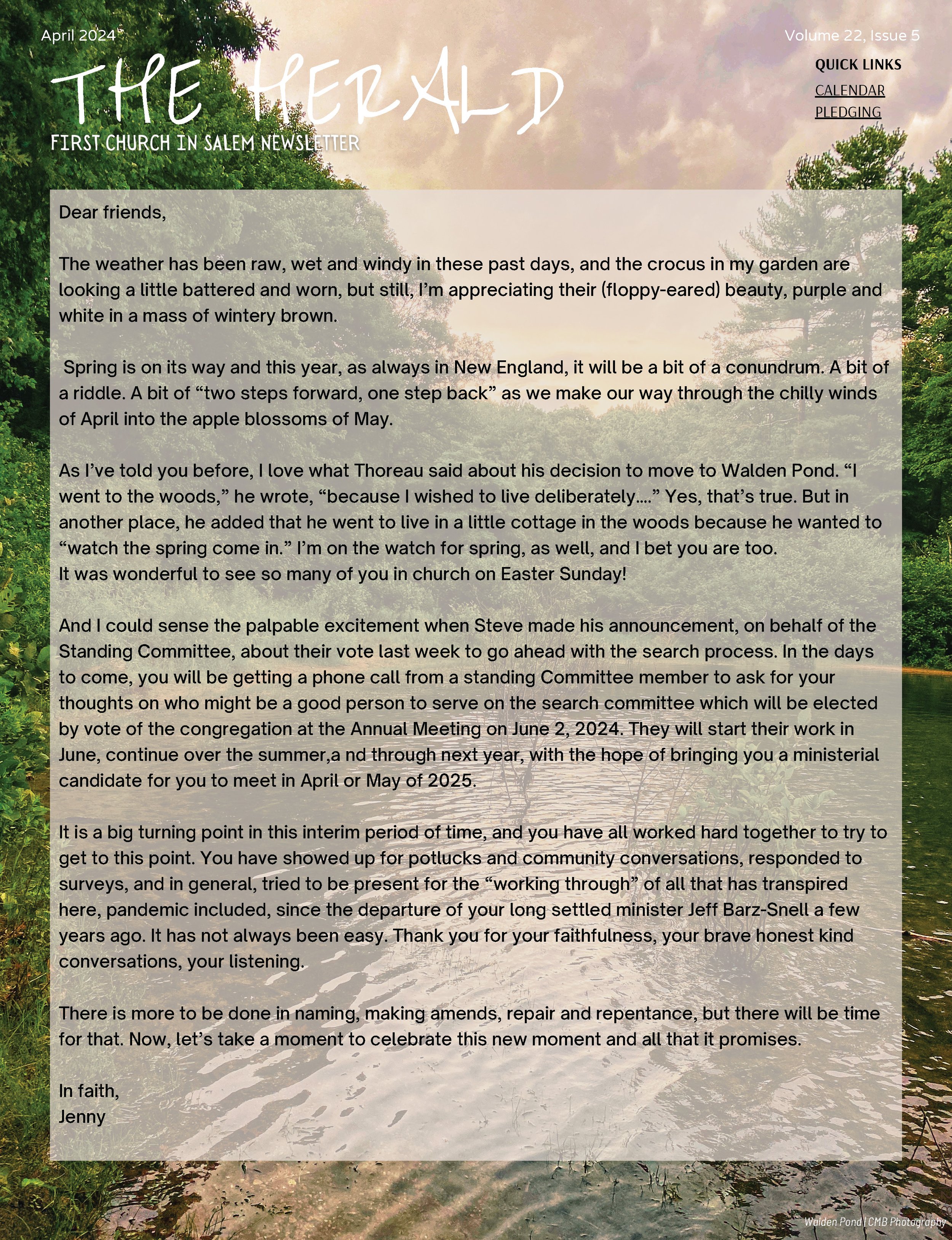
Salem, MA – First Church in Salem, Unitarian Universalist is delighted to announce that Danielle Garrett will join the congregation as its next minister in August 2025. Garrett succeeds Reverend Jenny Rankin, who has served the church in interim ministry since 2022.

Garrett, a graduate of Vanderbilt Divinity School, currently serves as Assistant Minister at First Unitarian Portland (Oregon). Before following her call to ministry, she spent a decade in Washington, D.C., as a nonprofit director and health care policy analyst. She holds a B.A. from the College of William and Mary and a Master of Public Affairs from the LBJ School of Public Affairs at the University of Texas.

Garrett brings to Salem a deep commitment to parish ministry, a passion for justice, and an unwavering belief in the transformative power of a good church potluck. A country music fan and seasoned pilgrimage enthusiast, she has accompanied congregations on spiritual treks through Spain and Scotland.  

First Church is eager to begin this new chapter with Garrett, celebrating its theological, philosophical, and spiritual diversity while continuing to move the historic and beloved church into the future. Together, the congregation will explore how to further embody the values of freedom, reason, interdependence, equity, justice, transformation, pluralism, and generosity to honor love as our guiding principle.

The wider community is warmly invited to meet Danielle Garrett during a special service on Sunday, May 11 at 10:30 a.m. at First Church in Salem. All are welcome.

Workshop Summary: Break Barriers, Build Beliefs (B4)

Hosted by the Ministerial Search Team

 On Saturday, November 9th, a thoughtful and curious crowd of 25 of us gathered in the Cleveland Room for a learning experience with the very warm and wise Rev. Amanda Schuber.  Rev. Schuber currently serves as a Developmental Minister at the High Street UU Church in Macon, GA. She shared some of the realities and challenges of living in the South while holding several marginalized identities; she did not record our session due to heightened safety concerns with the evolving political climate.  As one participant commented, the workshop “prompted great self-reflection for us as individuals and as a church with positive and inspiring ideas for how we move forward in love.”

Here are some key ideas from the workshop that we wanted to share with the full congregation:

Multiple identities:  We all hold more than one identity, and none of us wants to be identified with “one story,” be it one we are proud of or not. This is important to keep in mind, in relation with our ministers and their interests, and also with each other.

Belonging vs. Othering:  What is it that makes someone feel welcome, and that they could be a part of our community (be they a minister or a potential member)? It is vital that we look at all the ways that we connect with others, and what messages we send. Consider ways to practice Radical Hospitality at our services and during fellowship.

Understanding and Confronting Bias: We looked at different categories of bias, how to be more aware of them, and how they impact how we see the world (including how they could affect the selection process for the Search Team). We all carry biases (and they are not all bad), but we don’t want those beliefs to define how we approach and relate with people.

Understanding Microaggressions: We learned about the small actions (often subtle or unintentional) which can diminish another person, and how they have the potential to add up to “10,000 daily paper cuts.” 

Interrupting Microaggressions:  Rev. Schuber shared the fact that ministers with marginalized identities typically have shorter tenures because of silence from a congregation in the face of microaggressions, and the feeling of not being supported.  We all must be willing to step in and interrupt microaggressions and other behavior that goes against our shared values. This becomes more natural when there is a collective awareness of an articulated mission/vision/covenant, as we can “call each other back” into Covenant. Part of loving and caring for each other is helping one another do better.

Types of Bias and Microaggressions

Please see the B4 Discussion Guide for a helpful overview of types of bias and microaggressions.

Co-conspirators:  While it is important to be an ally, what is needed now even more are co-conspirators: people who are willing to actively join the fight and help amplify marginalized voices. Given the evolving cultural/ political landscape, people with marginalized identities will need support more than ever.  We have to be willing to take risks and to act in love, not out of fear…  we have work to do (in our congregation and in the wider world).  

____________________________

Results from the pre-workshop survey (completed by 62 people) illustrate some of the work we have to do:

  • More than half of the respondents said they weren’t sure if First Church has a mission and a vision statement. (We don’t! We also don’t have an articulated Behavior Covenant, other than our 1629 Covenant).

  • Only 35% felt “competent to interrupt a microaggression when it is happening between congregants.

  • Only 8% agreed that the “congregation has effective ways to engage and manage conflict amongst congregants over congregation-level issues.”

  • Only 11% felt that  “my congregation has a process for accountability when a congregant strays from behavioral expectation.”  

  • When asked if the church has offered formal opportunities to discuss topics such as anti-racism, diversity and justice, well over half of respondents replied no or unsure. 

______________________________

Some ideas for next steps– things we can work on together!

  • Using our Blue Sky visions to help develop inspiring vision and mission statements.

  • Enhancing our communications and marketing

  • Invigorating our Welcoming habits (while not overwhelming visitors)

  • Having pronoun stickers available for nametags

  • Helping keep our Little Free Library stocked

  • Bringing in additional speakers/workshop leaders on related topics

  • Participating in the UUA 2025 Common Read: Authentic Selves: Celebrating Trans and Nonbinary People and Their Families–already planned! 

  • Contributing to discussions and helping to support the development of a Behavior Covenant and other systems which support “Right Relations” in our congregation.

Notes prepared by Anna Brandenburg

Transition Team 2022-2024

The Transition Team at First Church in Salem from its formation in November 2022 until June 2024 led the congregation as we learned together what it means to be a church in transition. The members of the team were Deborah Greel, Jerrie Hildebrand, Eric Kenney, Patti Roka, and co-chairs Russell Lane and Melody Lee. We have been working under the guidance of our interim minister Rev. Jenny Rankin.

Year One
Our first order of business as a team was to write a covenant to guide our work together and remind us to bring our best selves to the table. Tackling this challenge helped us better understand some of the difficult dynamics at play within our congregation.
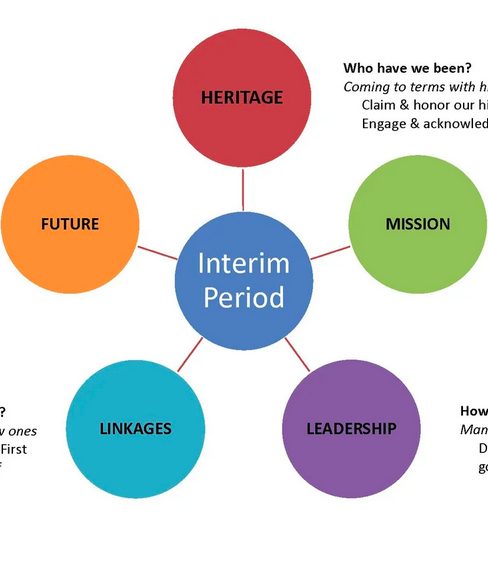
Next, we focused on the first of five UUA suggested interim goals: coming to terms with our past. We designed a series of Community Conversations to lead the congregation in a process of self-reflection and self-discovery. During these discussions we focused on the past five years of our congregational history. These included the departure of our long-time minister Jeff Barz-Snell, a one-year interim and search process to call a new settled minister, Elizabeth Ide, and her three-year tenure with us, which coincided with the challenges presented by Covid. Unpacking our varied responses to these events has given us a lot to talk about.

Year Two
During our second year of work, we focused on the second UUA interim goal: discovering our identity. We started off the year by distributing copies of Rabbi Danya Ruttenberg’s On Repentance and Repair: Making Amends in an Unapologetic World, which was the UUA Common Read for 2023-24, and leading discussion groups that focused on naming the harm caused by the actions of the congregation during the tenure of our last settled minister.
In November we held a community-building potluck and conducted a “Spirituality Snapshot” survey which highlighted the diversity in belief among our congregants. In February we led a Leadership retreat with members of the Standing Committee and the Deacons to encourage discussion among church leaders and assess our readiness for search. In April the Transition Team led a Sunday service on Shared Ministry to help the congregation learn more about what this means and what we already contribute to the church.
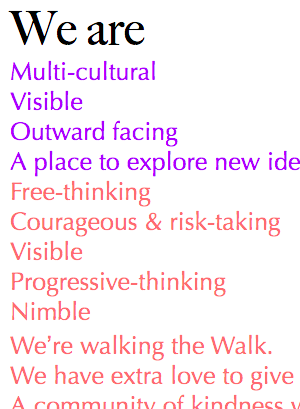
At the end of this year, our focus shifted to the fifth interim goal of looking into the future and thinking about who we want to become as a congregation.  Patti Roka, who stepped down from regular participation in the Transition Team, led the congregation in a Blue-Sky brainstorming event to envision how we would like to see our congregation develop over the next five years. Here are the lists of what folks came up with.


What we learned

One of the takeaways from our work as a team is the importance of talking to one another directly in times of conflict. We have recommended that the Standing Committee form a Right Relations Committee to address conflict in our church community and Rev. Jenny is available for mediated conversations.
Many thanks to everyone who participated in the potlucks, discussions, survey, and services hosted by the Transition Team. It has been important to come together both to listen to one another when we disagree and to dream about how we might grow in the future.  Let’s keep the creative juices flowing as we continue to learn and dream together. We extend our heartfelt gratitude to Rev. Jenny who has guided and shaped our work together. We could not have done it without you.

Five focus points of an Interim Period

Five focus points of an Interim Period

Blue Sky Brainstorming (click for full list)